
Key Points:
- Sustainability and the use of technology are very important whenever we talk about future trends of commercial spaces.
- Choice of location also matters in this regard.
- Modular construction is also rising among the future trends of commercial spaces.
The world is moving faster than we could’ve ever imagined, so are the businesses and their needs. Especially if we talk about commercial and industrial spaces. These are meant to be well-equipped in every way to bring out the best results for businesses.
Now, there have been a lot of trends that are being adopted by many of these spaces. If you are curious to know about the future trends of commercial spaces, you have to read this blog to the end. In this piece, we are going to elaborate on everything in depth, so that in case you are going to get a rental space accordingly, you know which one to get. Without wasting time, let’s start!
Smart Buildings
Previously, these types of buildings were very uncommon. But as the world is moving on, more businesses are going for smart buildings. Smart industrial spaces are based on the combination of IoT sensors, building management platforms, and AI to optimize energy, occupant comfort, and maintenance.
You’ll get a lot of benefits in return, like the best energy performance, healthy indoors, and even low prices. A lot of research shows that AI has now been used in this niche to cut down the time of construction, whether the sensory HVACs and lighting controls reduce the waste.
Examples:
- Real-time better monitoring of air and ventilation for the better health of people working
- It’ll predict failing chillers and pumps before a breakdown.
- Apps that allow the staff to book the desks, how to find the rooms for meetings, and also be able to control the temperature and light by touch.
Industrial Automation
Many industrial spaces, like storage units and warehouses, are speedily automating. A lot of changes have been witnessed, like robot delivery, mobile shuttles, and even the tech-based warehouse management systems, which let the operators take care of a spike in demand without messing anything up.
Even automation is not about removing people completely. Instead, it diverts the roles of humans to better supervision, quality control, and management of the systems. Your workers will be doing fewer manual tasks, and ultimately, your business will benefit from having better processing with zero to no error rate.
Some businesses do have one, and some have two automated systems. These include:
- Robotic picking arms
- Automated forklifts
Ultimately, this approach will let you help in testing what works, understanding the costs, and scaling without disruption. It is becoming affordable enough that even mid-sized businesses and startups can use this.
Automation is becoming affordable enough that even mid-sized companies can adopt these systems.
Location Matters a Lot
We know that online shopping has been in trend for years. But one thing that customers don’t compromise is the time of delivery. So, to make it possible, companies do need warehouses that are located near housing societies.
It is setting a trend for urban industrial spaces. Big cities are witnessing:
- Small warehouses
- Micro-fulfillment centers
- Dark stores
- Small level distribution hubs
You may think that these are smaller than the usual ones, but location comes first here. Also know about growing industries that need commercial space.
Old Offices Are Renovated
Big cities have seen a sudden rise in office vacancy rates as more people work remotely or in hybrid setups. Now, instead of these buildings remaining empty, developers are looking for new ways to occupy them. Adaptive reuse is one of the biggest real estate trends for resolving this issue.
Now people are changing the old offices into hotels, coworking spaces, apartments, pharmacies, and labs. As these buildings already have sturdy structures, elevators, and relevant utilities, they are good enough for conversion.
It also helps in reducing waste and construction, but also helps cities deal with housing shortages.
Keep in mind that not every office building is able to convert. Because some have very big floor plates or don’t have enough light, which makes them difficult to convert.
Sustainability is a Non-Negotiable Factor
Those days have vanished when we used to think of sustainability as a bonus. It is something that is expected by tenants, customers, and investors. Now, commercial and industrial spaces are going for green practices as they ultimately offer low costs, reduced carbon footprint, and even enhance the beauty of the spaces.
These include many upgrades, like:
- Smart HVAC Systems
- Energy Efficient Windows
- LED lights
- Rainwater recycling
- Rooftop solar installation
Even the older buildings have now been renovated with the addition of such sustainable options.
The majority of companies are now even considering the full life cycle of buildings. These include a decrease in waste during construction, sourcing of better materials, and improving the insulation, so the building stays efficient for years. With the rising concerns about the climate, sustainable buildings will never lose out on their value.
Modular Construction is on a Roll
Prefabricated and modular construction are rapidly becoming one of the most intelligent options for commercial and industrial projects. Rather than constructing the large structures on site, they are manufactured in factories and then delivered to the construction site.
The advantages of this method are hard to ignore. It is faster because multiple parts are built at the same time. It reduces waste because factory-controlled resources are more efficient in terms of materials, and it also lowers costs since labor and manufacturing are controlled.
Warehouses, hotels, hospitals, and even apartments are using modular techniques to speed up delivery and improve quality.
Final Thoughts
We have explored the future trends of commercial and industrial spaces. Buildings are now going towards sustainability and the adaptation towards the use of technology like AI and Robotics. Industrial locations are now moving far away from the residential areas. Also, modular construction is on the rise. Basically, buildings are now working on the concept of Less is more. It is all about, instead of reconstructing the space from scratch, buildings have been renovated with the required resources.
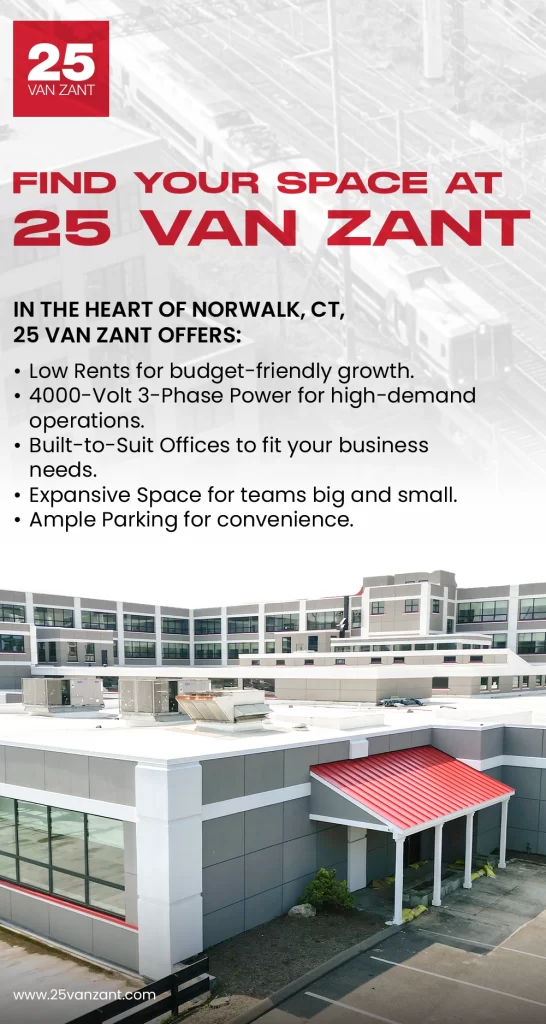
In case you are on the way to finding a space that actually cares for the tenants without spending extra, 25 Van Zant is offering industrial, business and commercial spaces for a variety of businesses. Our spaces are highly equipped with modern amenities as well. If you want to learn more about our spaces, do contact us now!
Frequently Asked Questions
What is an Automated Warehouse?
This is the type of environment where everything has been automated (for the inventory), from receiving to packing, picking, and shipping.
What are the 5 Cs of Hybrid Working?
These are the 5 Cs of Hybrid Working:
- Collaboration
- Communication
- Culture
- Connectivity
- Continuity
What are the three types of modular construction?
There are many types of modular construction, but these are the three common types:
- 2D Panels
- 3D Modules
- Hybrid Modular Construction